Reading Casino Signs on a First Visit
Reading casino signs on a first visit is easier when you distinguish routes, service choices and venue rules before deciding where to go next.
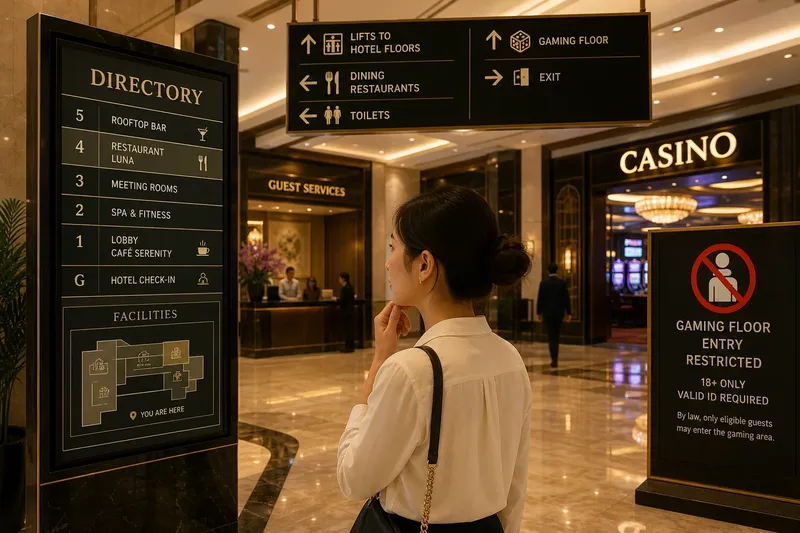
Reading casino signs on a first visit is easier when you separate routes, service choices and venue rules before acting. In a busy lobby, an arrow to the lifts, a dining directory and an entry notice may be close together, yet each answers a different question.
Imagine Mai arriving at a fictional casino hotel in Hanoi for dinner. She has arranged to meet a friend at a restaurant, but the lobby opens towards a gaming floor, a hotel lift bank and several service counters. Her task is to identify the signs that affect her destination and the boundaries she should not cross.
Sort signs by the decision they support
Mai looks at the lobby directory and groups the messages by purpose. This makes it easier to ignore information that does not help with her immediate choice.
- Directions identify places or routes through arrows, floor maps, lift labels and signs for exits or toilets.
- Choices help guests distinguish services, such as restaurant names, facility descriptions or activity listings.
- House information states conditions, boundaries or requests, including access rules, photography notices and conduct requirements.
A sign can serve more than one purpose. A restaurant panel might name a venue and show its location. Ask what decision the message supports: “Which way?” concerns direction; “Which service?” concerns choice; “What applies here?” concerns venue information.
Match route signs to the named destination
Mai searches the directory for the restaurant name rather than following the nearest arrow. The directory places it on an upper level and marks a lift route. Another arrow points towards the gaming floor, but it does not answer her question, so she leaves it aside.
Wayfinding often comes in a sequence: a directory identifies the destination, an arrow indicates a route, and a floor or room marker confirms arrival. If the destination label disappears or changes, do not infer the route from other guests’ movements. Ask a staffed information point to identify the relevant sign or corridor.
Check the exact wording. A hotel restaurant, café and buffet may be separate venues even when they are nearby. If a sign uses a shortened name that does not match the booking message, pause before entering a corridor marked for another service.
Use service listings to distinguish venues
At the lift bank, Mai sees a screen naming a restaurant, a bar and a café. She checks the restaurant’s name against the lobby directory. The screen helps her identify the service, while the directory supplies the route; neither message needs to do both jobs.
Icons and brief descriptions can make a listing quicker to scan, but an unfamiliar symbol should not decide a route by itself. Read its label and compare the venue name with the place you intend to reach. If two names appear similar, keep the distinction in view rather than assuming they share an entrance.
Her friend then messages that they are waiting at the restaurant’s lounge entrance. Mai now needs to distinguish two entrances, not choose another dining option. She looks for a separate entrance label on the directory before following any sign marked only with the restaurant name.
Read venue rules before crossing an entrance
Near the gaming floor, Mai sees a notice stating that entry is limited to eligible guests. It sets a condition; it is not an invitation to proceed. Since she is going to the restaurant, she follows the separate lift signs and stays outside the gaming area.
House information may cover access, conduct, photography or identification. Read the full notice, including smaller wording beneath the heading. A symbol attracts attention, but its accompanying text explains what the venue is asking guests to do.
If a notice is unclear or conflicts with a sign nearby, stop before crossing the boundary and ask a member of staff to explain the posted rule. A general directory may not describe conditions for a particular entrance. For requirements that depend on venue policy or local rules, seek guidance from the venue or a qualified professional where appropriate.
Resolve the remaining question with the right sign
Mai reaches the lift lobby and sees two restaurant names on the same level. Her uncertainty is no longer about the floor; it is about which entrance serves her booking. She asks the attendant beside the lifts, who points to the lounge entrance. A small sign bearing the restaurant’s name confirms that she has reached the right place.
Reading more signs is not always the answer. If you do not know the destination, use a directory. If you are choosing between services, compare their names and descriptions. If an entrance rule is unclear, read the notice and ask staff before proceeding.
Say a visitor sees an arrow marked “Dining” but cannot tell whether it leads to a booked restaurant or a food court. The visitor checks the directory for the restaurant’s name, then asks a host to identify the route when the directory remains ambiguous. The expected observable result is a named destination and a route to check, rather than a guess based on a broad category sign.
What should a first-time visitor check?
Which sign should I read first?
Start with the sign that answers the immediate question. If you need a location, use the directory; if you are comparing services, read the listings; if you are at an entrance, read its rules.
What if two arrows point in different directions?
Check whether the labels name different destinations or separate entrances. If they still do not resolve your route, pause and ask staff rather than choosing by the arrow’s appearance alone.
Do icons mean the same thing in every venue?
Common symbols can be useful, but meaning may depend on the venue and its accompanying wording. Read the label beside an unfamiliar icon, especially when it concerns access or conduct.
When should I ask an employee?
Ask when a destination is missing from the directory, signs conflict or a rule is unclear. Tell the staff member the venue or entrance you are trying to find so they can address the specific uncertainty.
Use each sign for one clear decision
Mai reaches the restaurant without entering the gaming floor. She used the directory to locate the venue, the service listing to distinguish its entrance and the access notice to recognise a boundary she did not need to cross. The signs were useful because she read each for the decision it could support.
When reading casino signs on a first visit, keep the next question specific: where is the destination, which service is it, or what rule applies at this entrance? That distinction helps you move with purpose and makes it easier to explain what you need if a sign leaves the route unresolved.