The Welcome Starts Before the Front Desk
Map the welcome before the front desk to spot where arriving guests lose their bearings and give staff a clear, well-timed first point of contact.
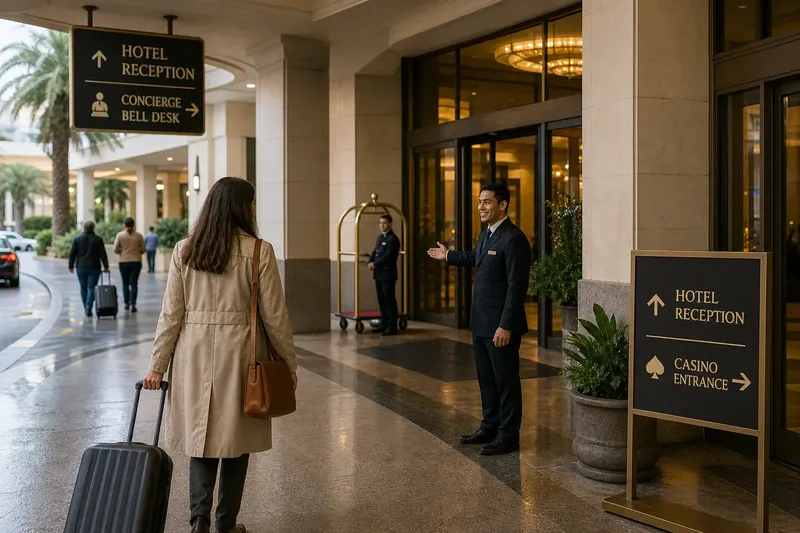
The welcome before the front desk begins with the first cue a guest can read: a doorway, a sign, a uniform, or a person who looks available to help. In a hotel, resort or casino, that sequence shapes whether arrival feels legible or confusing before anyone asks for a room number. A simple paper map can show where the cues work, where they disappear and who should meet the guest next.
Arrival is a sequence, not a single greeting
Guests rarely arrive with their attention free. They may be pulling a case, checking a booking message, keeping a child close or looking for the entrance they were told to use. The first welcome has to meet that divided attention. A polished reception desk cannot make up for a confusing approach if the guest has already passed the entrance twice.
Think of arrival as a chain of small decisions. The guest approaches the property, recognises an entrance, crosses a threshold, finds the next direction and identifies a person who can help. Each cue either confirms the route or leaves a question open. A sign can point towards reception; a visible host can show that the entrance is in use; a clear line of sight can make the next move feel obvious.
In a casino hotel, the approach may pass through a busy public lobby, a gaming floor or a shared resort entrance. The guest may be looking for hotel check-in rather than the gaming area. The welcome should make that distinction visible without assuming that every visitor already understands the building.
Give the first cue something useful to say
A good arrival cue answers the question the guest is likely to have at that point. At the kerb, that may be which door to use. Just inside, it may be where hotel reception is. Near a shared lobby, it may be how to distinguish hotel services from casino facilities.
Keep the wording direct and consistent. If a sign says “Hotel reception” but staff call the same place “check-in”, a tired guest has to reconcile two labels. That is a small demand, but several small demands can make a route feel harder than it is. Use the same familiar terms across signs, booking information and spoken directions wherever possible.
Placement matters as much as wording. A sign hidden behind a plant or placed beyond the point where a guest must choose a direction arrives too late. Look from the guest’s approach, not from the desk: can the sign be seen before the turn, and can a person identify the next destination without stopping in the flow of people?
- At the entrance, identify the correct door or the service available there.
- At the first internal junction, mark the route to reception or the relevant guest service.
- At a shared hotel and casino entrance, distinguish the hotel welcome from gaming-floor access.
- Where guests may pause, make space to stop without blocking other arrivals.
- Keep signs readable from the direction guests approach, rather than only from behind the desk.
Make the first human greeting easy to recognise
A guest should not need to guess whether someone is available to help. A receptionist may be occupied with another arrival, while a host, concierge or porter is nearby. A visible role cue—name badge, uniform or a simple greeting—can clarify who can answer a first question. The aim is not to station a staff member at every point. It is to avoid leaving the guest unsure whether help is welcome.
The first exchange can be brief. “Welcome. Reception is just ahead, and I can point you there” gives orientation as well as courtesy. If the guest is already walking in the right direction, a nod and a clear invitation to ask may be enough. A greeting that demands an immediate conversation can be awkward when someone is still managing luggage or checking details.
Timing matters. A greeting delivered before the guest has found the entrance can feel misplaced; one delivered after the guest has stood searching can feel late. Staff can watch for practical signals: a guest scanning signs, slowing at a junction, or looking between a phone and the room. Those are invitations to offer a concise direction, not assumptions about what the guest needs.
Map the welcome on paper before changing the space
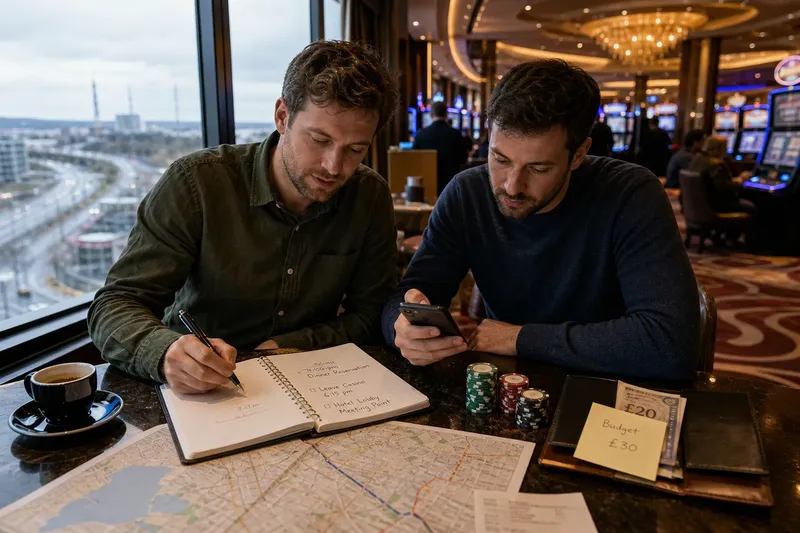
A paper map keeps the exercise simple and makes it easier for reception, porters and guest-service staff to compare what they see. Use a sheet of A4 paper, a pencil and a few coloured pens. You do not need an architectural drawing. A rough plan of the guest route is more useful than a polished floor plan that leaves out the human hand-offs.
- Draw the guest’s likely approach, including the entrance they are expected to use.
- Mark each point where the guest must choose a direction, stop, wait or identify a service.
- Write the cue available at each point: a sign, sightline, staff member, doorway or lack of information.
- Draw an arrow for the route to reception and note who is meant to offer the first human greeting.
- Circle any point where the guest could reasonably ask, “Am I in the right place?”
- Add one practical change beside each circled point, then decide who will review it with the relevant team.
Keep the map honest. Mark what a person approaching the entrance can actually see, not what staff know is there. If the reception desk is visible only after passing a column, draw that obstruction. If a member of staff is usually at the entrance only during certain periods, note the variation rather than drawing an imaginary permanent presence.
Use the map to find the quiet gaps
The most revealing marks are often the spaces between services. A guest may be guided from the car park to the entrance, then left without a cue once inside. Or a sign may point to reception, but the route may pass a queue that makes it unclear whether the guest should join it or continue to the desk.
Ask someone who does not work at the property to follow the drawn route and say what they would do at each point. This is not a formal audit; it is a way to catch assumptions. Staff often know that a particular doorway leads to the hotel, while a first-time visitor sees only a doorway beside a busy public space.
Say a guest arrives at a resort entrance that serves both hotel check-in and a casino. The map shows a sign for “Reception” behind a column, visible only after the guest steps inside. The team could move the sign to the approach and ask a host near the threshold to offer a short direction. The observable aim is that guests can recognise the hotel route before entering the busier lobby, not that every arrival follows the same script.
When a change depends on signage, access arrangements or property rules, check the relevant instructions and local requirements before moving or adding anything. For the map itself, keep the first pass focused on the guest’s route and the people responsible for each greeting.
Keep orientation separate from the full check-in conversation
The first greeting is not the moment to deliver every detail about the stay. A guest may need a direction before they are ready to hear about breakfast, luggage storage, loyalty benefits or the resort’s facilities. Give the immediate answer first, then let the guest choose whether to continue.
This distinction matters in a busy lobby. A host can point out reception and indicate where to wait, while the receptionist handles identity checks and booking details. At a casino resort, a guest asking for the hotel may not want information about gaming. Staff should answer the stated need and avoid treating proximity to the gaming floor as permission to promote it.
For teams, the paper map can note where the first exchange ends and the next service begins. That prevents a welcome from turning into a hand-off that leaves the guest standing between departments. A clear phrase—“The reception team will take it from here”—can make the transition visible without adding a long explanation.
Where does the welcome sequence usually break?
What should the first sign tell an arriving guest?
It should answer the next decision, such as which entrance to use or where hotel reception is. Avoid placing several unrelated directions on the first sign if one clear instruction will help the guest move forward.
Who should give the first human greeting?
The person best placed to notice uncertainty and offer a useful direction may be a host, porter or receptionist. Make the role recognisable, and agree how that person hands the guest to the next service.
How can a team map a welcome without a floor plan?
Draw the approach and route on paper, then mark decision points, visible cues and staff hand-offs. The sketch should reflect what a first-time visitor can see, including obstacles and gaps.
What belongs in the first greeting?
A welcome, a useful direction and an invitation to ask are usually enough. Save detailed information for the point when the guest is ready to receive it.
Review the route from the guest’s point of view
Once the paper map is complete, walk the arrival path at an unhurried pace. Look for the moment when a guest first knows they have reached the right entrance, then check whether the next cue appears before they need it. Notice whether staff can see a guest who pauses, and whether the route to reception remains clear when the lobby is busy.
Make one change at a time when the cause is uncertain. Moving a sign, clarifying a phrase or adjusting who offers the first greeting can make the route easier to understand. Record what changed on the same sheet, then revisit the map with the staff who work at those points.
A useful welcome is not a performance delivered at the desk. It is a sequence in which each cue arrives early enough to help, and each person knows how to make the next step clear. The paper map gives the team a shared view of that sequence—and a practical way to notice where a guest is left to work it out alone.